
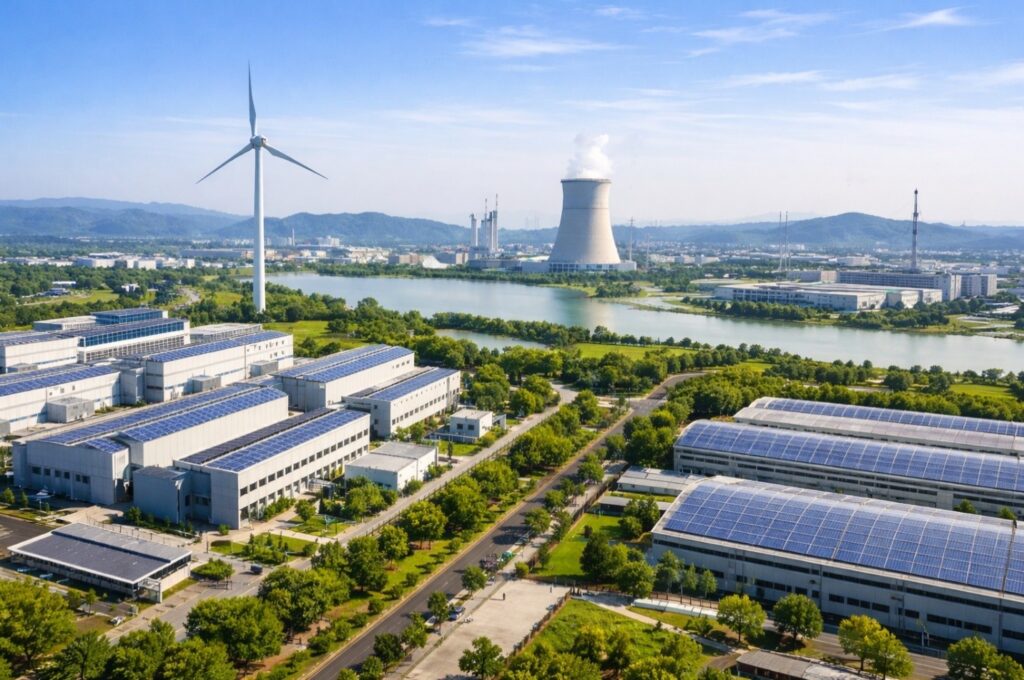
Implications for Industrial Governance, Energy Efficiency, and Carbon Reduction
对工业治理、能源效率与碳减排的影响
Introduction
On December 31, 2025, China officially implemented the revised national standard GB/T 36132-2025 – General Principles for Green Factory Evaluation. This marks the first major revision of the green factory standard since its initial release in 2018 and represents a decisive shift in China’s green manufacturing governance—from policy-driven encouragement toward quantitative, performance-based evaluation and compliance.
The new standard is not merely a technical update. It establishes a system-level framework that embeds energy decarbonization, resource efficiency, clean production, product greenness, and land-use optimization into a unified evaluation logic. For manufacturing enterprises, this means that “green factory” status is no longer symbolic or checklist-based, but instead tied to measurable performance indicators, benchmark thresholds, and continuous improvement mechanisms.
CNEUCN is ready to support industrial enterprises in interpreting the new standard, aligning factory operations with its requirements, and translating compliance into long-term decarbonization value.
引言
2025 年 12 月 31 日,中国正式实施修订后的国家标准 GB/T 36132-2025《绿色工厂评价通则》。这是自 2018 年该绿色工厂标准首次发布以来的首次重大修订,标志着中国绿色制造治理体系发生了决定性转变——从以政策引导为主,迈向以量化指标和绩效导向为核心的评价与合规机制。
这一新标准并非简单的技术更新,而是构建了一个系统性框架,将能源脱碳、资源效率、清洁生产、产品绿色属性以及土地利用优化统一纳入同一套评价逻辑之中。对于制造业企业而言,这意味着“绿色工厂”不再是象征性标签或清单式达标,而是与可量化的绩效指标、基准阈值以及持续改进机制直接挂钩。
CNEUCN 已做好准备,支持工业企业解读新标准、将工厂运营与其要求对齐,并将合规要求转化为长期的脱碳价值。
From Policy Guidance to Quantitative Evaluation: What Has Changed
The 2025 revision of GB/T 36132 introduces a fundamental change in how green manufacturing performance is assessed.
Unlike the 2018 version, which focused primarily on qualitative management practices and directional guidance, GB/T 36132-2025 adopts a performance-oriented logic, emphasizing data-driven assessment across multiple dimensions. At the core of the revision is the so-called “new five-fold framework”, which structures evaluation around five integrated pillars:
1. Energy and carbon performance, including energy efficiency, energy structure optimization, and decarbonization pathways.
2. Resource utilization efficiency, covering raw materials, water, and circular use of by-products.
3. Clean production processes, focusing on pollution prevention, emission intensity, and process optimization.
4. Product-level greenness, addressing lifecycle impacts, eco-design, and downstream environmental performance.
5. Land-use and spatial efficiency, emphasizing intensive land use and optimized factory layouts.
Each pillar is supported by quantitative indicators and benchmark references, signaling a clear regulatory expectation: green manufacturing must be measured, verified, and continuously improved, rather than declared.
从政策引导到量化评价:发生了哪些变化
GB/T 36132 的 2025 年修订版,在绿色制造绩效评估方式上引入了根本性变化。
与 2018 版主要聚焦定性管理实践和方向性指引不同,GB/T 36132-2025 采用了以绩效为导向的逻辑,强调在多个维度上进行数据驱动的评估。此次修订的核心在于所谓的“新五维框架”,该框架围绕五个相互整合的支柱构建评价体系:
1. 能源与碳绩效,包括能源效率、能源结构优化以及脱碳路径。
2. 资源利用效率,涵盖原材料、水资源以及副产物的循环利用。
3. 清洁生产过程,重点关注污染预防、排放强度和工艺优化。
4. 产品层面的绿色属性,涉及生命周期影响、生态设计以及下游环境绩效。
5. 土地利用与空间效率,强调集约化用地和工厂布局优化。
每一个支柱均配套量化指标和基准参考值,清晰传递出监管层的预期:绿色制造必须被测量、被核查,并实现持续改进,而不再只是被声明。
Implications for Manufacturing Enterprises: Compliance as a Systemic Upgrade
The entry into force of GB/T 36132-2025 significantly raises the bar for enterprises seeking green factory recognition and broader ESG credibility.
First, compliance now requires cross-departmental coordination. Energy management, production planning, procurement, environmental compliance, and digital systems must work together to generate consistent, auditable data. Fragmented or siloed approaches will no longer suffice.
Second, the standard effectively pushes factories to integrate decarbonization into core operational decision-making. Energy structure optimization, electrification, renewable integration, and process efficiency improvements are no longer optional enhancements, but central components of evaluation.
Third, GB/T 36132-2025 strengthens the link between factory-level performance and broader climate objectives, reinforcing alignment with China’s carbon peaking and neutrality goals. For export-oriented manufacturers, especially those engaged in China–EU value chains, this alignment also supports compliance with emerging international requirements on carbon disclosure, product sustainability, and supply-chain transparency.
对制造业企业的影响:将合规视为系统性升级
GB/T 36132-2025 的正式实施,显著提高了企业获得绿色工厂认定以及更广泛 ESG 可信度的门槛。
首先,合规要求企业实现跨部门协同。能源管理、生产计划、采购、环境合规以及数字化系统必须协同运作,生成一致且可审计的数据。碎片化或各自为政的做法将不再可行。
其次,该标准实际上推动工厂将脱碳目标嵌入核心运营决策之中。能源结构优化、电气化、可再生能源接入以及工艺效率提升,不再是可选的附加项,而是评价体系的核心组成部分。
第三,GB/T 36132-2025 强化了工厂层面绩效与更宏观气候目标之间的关联,进一步巩固其与中国碳达峰、碳中和目标的一致性。对于出口导向型制造企业,尤其是深度参与中欧价值链的企业而言,这种一致性也有助于应对日益显现的国际要求,包括碳信息披露、产品可持续性以及供应链透明度。

A Bridge Between Domestic Standards and International Expectations
One of the most significant features of GB/T 36132-2025 is its implicit convergence with international green manufacturing and climate governance trends.
The emphasis on quantified indicators, lifecycle thinking, and continuous performance improvement mirrors approaches seen in the international – especially EU – industrial policy, corporate sustainability reporting, and carbon management frameworks. As such, the new standard can function as a bridge between domestic green factory certification and international ESG, carbon accounting, and decarbonization expectations.
This convergence creates both opportunity and pressure for enterprises. Those able to translate GB/T 36132 compliance into robust carbon and sustainability narratives will be better positioned in cross-border cooperation, investment evaluation, and market access—particularly in China–EU industrial collaboration contexts.
连接国内标准与国际预期的桥梁
GB/T 36132-2025 最显著的特征之一,在于其与国际绿色制造和气候治理趋势的隐性趋同。
其对量化指标、生命周期思维以及持续绩效改进的强调,与国际(尤其是欧盟)在工业政策、企业可持续披露以及碳管理框架中的方法高度一致。因此,该新标准有望成为连接国内绿色工厂认证与国际 ESG、碳核算及脱碳预期之间的桥梁。
这种趋同既带来机遇,也带来压力。能够将 GB/T 36132 合规要求转化为有力的碳与可持续发展叙事的企业,将在跨境合作、投资评估以及市场准入方面占据更有利的位置——尤其是在中欧产业合作的背景下。
From Standard Interpretation to Factory-Level Transformation
While GB/T 36132-2025 provides a clear evaluation framework, implementation remains highly complex. Many enterprises face challenges in understanding indicator logic, establishing baselines, designing decarbonization pathways, and coordinating multiple technical and managerial dimensions.
This is where CNEUCN’s integrated service model becomes particularly relevant.
CNEUCN does not approach green factory compliance as a single certification exercise, but as a systematic upgrading process that combines policy interpretation, technical assessment, and strategic decarbonization planning and supply of specific technologies and equipment necessary to reach those targets.
Key areas of CNEUCN’s support include:
• Standard interpretation and gap analysis, helping enterprises map existing factory performance against GB/T 36132-2025 indicators and identify priority improvement areas.
• Energy and carbon diagnostics, covering energy structure, efficiency benchmarking, emissions profiling, and decarbonization potential assessment.
• Integrated upgrade roadmaps, aligning green factory requirements with medium- and long-term carbon reduction strategies and investment planning.
• Cross-border alignment, supporting enterprises engaged in China–EU cooperation to ensure domestic compliance also strengthens international ESG and climate positioning.
• Provision of targeted technologies and equipment, selected and integrated to effectively meet the technical requirements imposed by the new policy framework.
By integrating policy, technology, and strategic advisory, CNEUCN advisory enables factories to move beyond compliance toward measurable, scalable, and credible decarbonization outcomes, while also delivering substantial reductions in energy-related operating costs.
从标准解读到工厂层面的转型
尽管 GB/T 36132-2025 提供了清晰的评价框架,但其落地实施依然高度复杂。许多企业在理解指标逻辑、建立基准线、设计脱碳路径以及协调多项技术与管理要素方面面临挑战。
这正是 CNEUCN 综合服务模式 尤为关键的地方。
CNEUCN 并不将绿色工厂合规视为一次性的认证行为,而是将其作为一个系统性升级过程,融合政策解读、技术评估、战略性脱碳规划,以及为实现目标所必需的具体技术与设备的供给。
CNEUCN 的重点支持领域包括:
• 标准解读与差距分析,帮助企业将现有工厂绩效与 GB/T 36132-2025 指标进行对标,识别优先改进领域。
• 能源与碳诊断,涵盖能源结构分析、效率对标、排放画像以及脱碳潜力评估。
• 一体化升级路线图,将绿色工厂要求与中长期减碳战略及投资规划相衔接。
• 跨境对齐支持,协助参与中欧合作的企业,确保国内合规同时强化其国际 ESG 与气候定位。
• 定向技术与设备供给,通过有针对性的选择与集成,有效满足新政策框架所提出的技术要求。
通过整合政策、技术与战略咨询,CNEUCN 的咨询服务帮助工厂超越合规本身,实现可衡量、可扩展且可信的脱碳成果,同时带来能源相关运营成本的显著降低。
Supporting Industrial Decarbonization at Scale
At a system level, GB/T 36132-2025 signals China’s intention to embed decarbonization directly into the operational logic of manufacturing. The standard’s quantitative orientation ensures that green transformation is no longer abstract, but anchored in factory-level performance and accountability.
By supporting enterprises in translating national standards into actionable transformation pathways, CNEUCN contributes to a broader ecosystem in which industrial upgrading, carbon reduction, and international cooperation reinforce one another.
As China and Europe continue to deepen collaboration on climate action, industrial decarbonization standards like GB/T 36132-2025 will play an increasingly important role in shaping shared expectations—and in determining which enterprises are prepared for the next phase of the low-carbon transition.
在规模化层面支持工业脱碳
从系统层面看,GB/T 36132-2025 传递出中国将脱碳直接嵌入制造业运营逻辑的明确意图。该标准的量化取向,确保绿色转型不再停留在抽象层面,而是落实到工厂层面的绩效与责任之上。
通过支持企业将国家标准转化为可执行的转型路径,CNEUCN 正在推动形成一个更广泛的生态体系,在这一体系中,产业升级、碳减排与国际合作相互强化、相互促进。
随着中国与欧洲在气候行动领域持续深化合作,诸如 GB/T 36132-2025 这样的工业脱碳标准,将在塑造共同预期方面发挥愈发重要的作用——同时也将决定哪些企业已为低碳转型的下一阶段做好准备。
Conclusion
The implementation of GB/T 36132-2025 marks a critical milestone in China’s green manufacturing journey. By shifting toward quantitative, performance-based evaluation, the new standard elevates green factory development from a policy aspiration to an operational requirement.
For manufacturing enterprises, this transition demands integrated action across energy, production, resources, and management systems.
As the standard takes effect and implementation accelerates in 2026, the ability to translate GB/T 36132-2025 into real-world factory transformation will become a defining factor in China’s industrial decarbonization progress—and in the future of China–EU climate and industrial cooperation.
CNEUCN’ s mission aims to deliver value through comprehensive, cross-disciplinary support that links compliance with long-term decarbonization and international alignment.
结论
GB/T 36132-2025 的实施,标志着中国绿色制造进程中的一个关键里程碑。通过向量化、绩效导向的评价体系转变,新标准将绿色工厂建设从政策愿景提升为明确的运营要求。
对于制造业企业而言,这一转型要求在能源、生产、资源以及管理系统之间采取高度协同的综合行动。
随着标准正式生效并在 2026 年加速落地,能否将 GB/T 36132-2025 转化为现实中的工厂转型成果,将成为衡量中国工业脱碳进展的重要标志——也将深刻影响中欧气候与产业合作的未来走向。
CNEUCN 的使命在于,通过全面、跨学科的支持体系,将合规要求与长期脱碳目标及国际对齐紧密连接,持续为产业转型创造价值。
 ZH
ZH