
People-Centred Decarbonisation — How people-centred design is reshaping China–EU collaboration in zero-carbon educational and public buildings
以人为本的脱碳路径 — 人本导向设计如何重塑中欧在零碳教育与公共建筑领域的合作
Introduction
As global decarbonisation progresses, the limits of energy- and carbon-centric building strategies are becoming increasingly visible. While operational efficiency remains essential, it alone cannot define the long-term value or social impact of the built environment.
Both China and the European Union are moving toward a more holistic understanding of sustainable buildings — one that integrates carbon reduction with health, comfort, and inclusivity. This shift is particularly evident in public and educational buildings, where indoor environmental quality directly affects vulnerable groups such as children.
Zero-carbon buildings are emerging as a strategic entry point for deeper China–EU cooperation, with people-centred design becoming a shared foundation rather than a secondary consideration.
引言
随着全球脱碳进程的不断推进,以能源和碳排放为核心的建筑策略,其局限性正日益显现。尽管运行效率依然至关重要,但仅凭效率本身,已无法界定建成环境的长期价值及其社会影响。
中国与欧盟正逐步形成对可持续建筑更加整体化的认知——这一认知将减碳目标与健康、舒适性及包容性有机结合。该转变在公共建筑和教育建筑领域尤为明显,因为室内环境质量直接影响包括儿童在内的脆弱群体。
零碳建筑正逐渐成为深化中欧合作的重要切入点,而以人为本的设计不再是附属考量,而是成为双方共同的基础性理念。
Policy and Market Context: A Converging Direction
China and the European Union are approaching human-centred decarbonisation from different historical and institutional starting points. However, their policy trajectories and market signals are increasingly aligned, particularly in the building sector, where carbon reduction, energy efficiency, and social outcomes are becoming inseparable.
In China
Rapid urbanisation and large-scale public investment have shifted expectations beyond basic compliance with energy standards. Public buildings are increasingly expected to deliver both environmental performance and improved quality of life, especially in socially sensitive sectors such as education and childcare. Key drivers behind this shift include:
• Growing awareness of indoor air quality and thermal comfort, particularly in schools and kindergartens, where health, cognitive performance, and long-term wellbeing are closely linked to indoor environmental conditions.
• Policy emphasis on high-quality urban development, aligning carbon peaking and neutrality targets with broader goals for liveable, people-oriented cities.
• Rising demand for demonstrative projects that integrate low-carbon technologies with social value, providing replicable references for local governments and developers.
These trends reflect China’s broader transition from scale-driven growth toward quality-oriented development, where buildings are viewed as long-term public assets rather than short-term technical deliverables.
In Europe
Human-centred design principles have been embedded in low-energy building practices for decades. Energy efficiency policies have increasingly evolved toward more holistic frameworks that explicitly recognise the interaction between climate action and human wellbeing. This evolution is supported by:
• Long-standing integration of indoor environmental quality into building regulations and voluntary standards, linking energy performance with comfort and health outcomes.
• Growing policy recognition of health–climate co-benefits, particularly in the context of climate adaptation, resilience, and public health.
• Pilot programmes prioritizing educational and public buildings, using them as testbeds for innovative zero-carbon and low-energy design approaches.
This convergence creates a strong and timely rationale for China–EU cooperation. By combining China’s implementation scale and speed with Europe’s methodological maturity and human-centred design experience, both sides can jointly advance scalable, people-focused zero-carbon building models.
政策与市场背景:趋同的发展方向
中国与欧盟在人本脱碳路径上的起点各不相同,源于不同的历史背景与制度体系。然而,其政策走向与市场信号正日益趋同,尤其是在建筑领域,减碳、能效提升与社会效益正变得密不可分。
在中国
快速的城市化进程与大规模公共投资,正在推动建筑领域的预期从“满足最低能效标准”转向更高层次的综合价值实现。公共建筑正日益被期待在实现环境绩效的同时,显著提升生活质量,尤其是在教育与托育等社会敏感领域。推动这一转变的关键因素包括:
• 对室内空气质量和热舒适性的关注持续提升,尤其是在学校和幼儿园,健康、认知表现与长期福祉与室内环境条件密切相关。
• 政策层面对高质量城市发展的强调,将碳达峰、碳中和目标与宜居、以人为本的城市建设目标相结合。
• 对示范性项目的需求不断增长,这类项目能够将低碳技术与社会价值相融合,为地方政府和开发主体提供可复制的实践范例。
这些趋势反映了中国从“规模驱动型增长”向“质量导向型发展”的整体转型,在这一过程中,建筑被视为长期公共资产,而非短期的技术交付成果。
在欧洲
以人为本的设计理念已在低能耗建筑实践中深耕数十年。能效政策逐步演进为更加整体化的框架,明确承认气候行动与人类福祉之间的相互作用。这一演进主要体现在:
• 长期将室内环境质量纳入建筑法规与自愿性标准体系,将能效表现与舒适性和健康结果相联结。
• 政策层面对“健康—气候协同效益”的认知不断增强,尤其是在气候适应力、韧性建设与公共健康领域。
• 以教育与公共建筑为重点的试点项目,将其作为创新型零碳和低能耗设计方法的试验场。
这种趋同为中欧合作提供了坚实且及时的现实基础。通过结合中国在实施规模与推进速度上的优势,以及欧洲在方法论成熟度和人本设计经验方面的积累,双方可共同推动可规模化、以人为核心的零碳建筑模式。
Case Value: NordiQ’s Tianfu Zero-Carbon Kindergarten
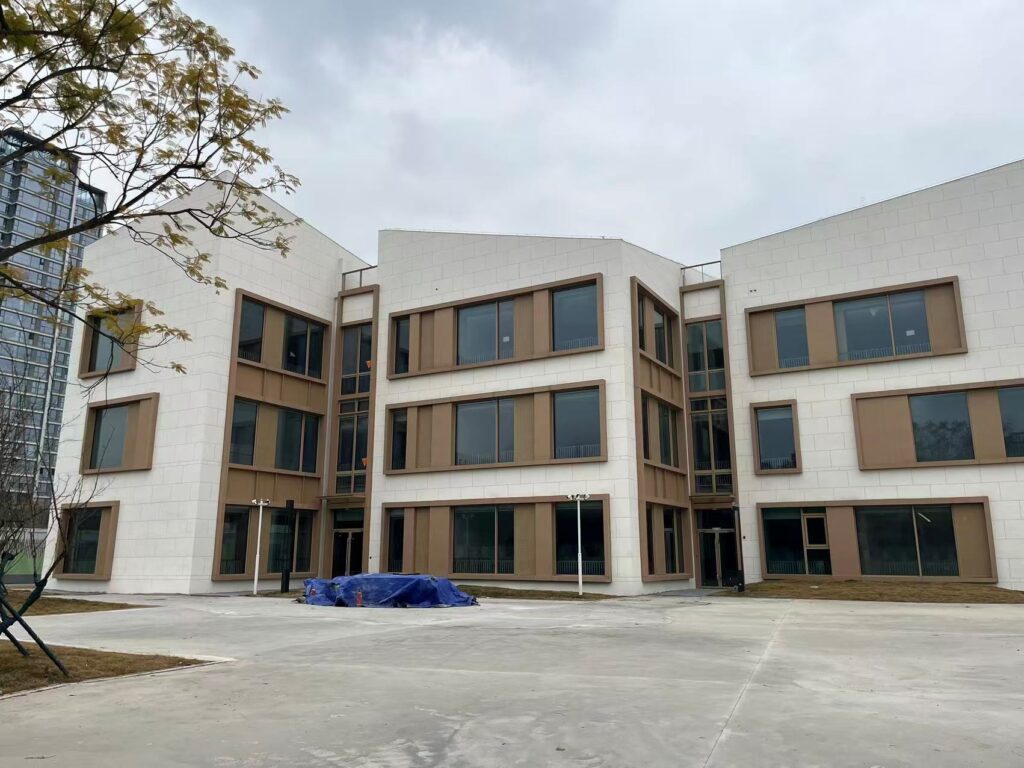
NordiQ’s Tianfu Zero-Carbon Kindergarten represents a policy-relevant and practice-oriented example of how human-centred decarbonisation can be realised within China’s public building sector.
The project was certified as a nearly zero-energy building by the China Association of Building Energy Efficiency in December 2022, confirming its alignment with nationally recognised performance benchmarks. More importantly, it demonstrates how low-carbon and near-zero-energy objectives can be integrated with health, comfort, and educational quality, rather than treated as standalone technical targets.
Located in Chengdu’s Tianfu Headquarters Business District, the kindergarten responds directly to China’s “dual-carbon” goals while addressing growing societal expectations for high-quality educational environments. The project adopts a “passive-first, active-optimised” design philosophy, combining architectural strategies, smart energy systems, and renewable energy integration into a coherent technical framework.
At the core of the project is a unified design approach that integrates multiple performance objectives:
• Ultra-low energy demand, achieved through a high-performance building envelope, optimised orientation, and passive design measures that significantly reduce baseline energy consumption and operational carbon emissions.
• Stable indoor thermal conditions and high air quality, supported by advanced ventilation and heat recovery systems, ensuring a healthy and comfortable learning environment that responds to children’s physiological needs.
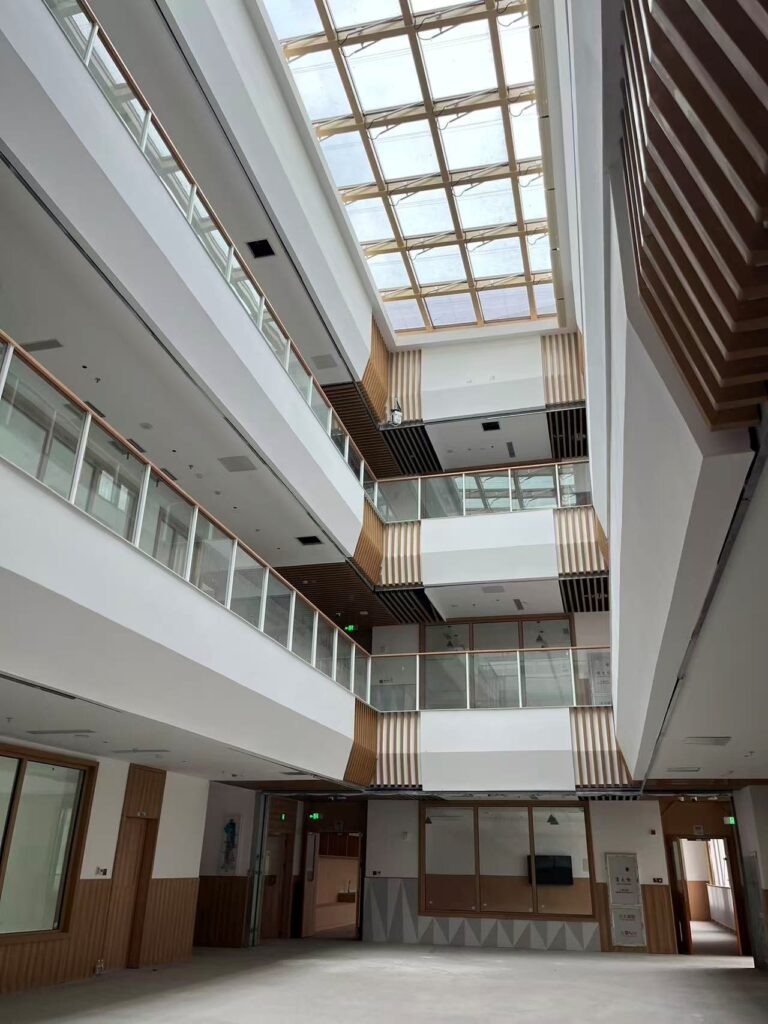
• Child-friendly spatial design, informed by Nordic educational philosophy, emphasising daylight access, spatial openness, and environments that support learning, interaction, and wellbeing.
These outcomes are supported by a set of integrated technical solutions that illustrate how human-centred design and decarbonisation can reinforce each other rather than compete:
• Building-integrated photovoltaics (BIPV), covering approximately 30% of the roof area, enabling on-site renewable electricity generation and supplying a significant share of the kindergarten’s daily energy demand.
• Full heat recovery fresh air systems, combining high-efficiency ventilation with intelligent air quality monitoring to ensure continuous indoor comfort while reducing energy losses.
• Air-source heat pump systems, delivering high-efficiency domestic hot water with substantially lower energy input and reduced carbon intensity compared to conventional systems.
• Smart energy management and sub-metering, allowing real-time monitoring and optimisation of energy use across lighting, HVAC, and plug loads.
Beyond technical performance, the project highlights a broader redefinition of value in zero-carbon buildings. Carbon reduction is not positioned as an abstract or invisible achievement, but as a tangible contributor to everyday experience. The kindergarten functions as both an educational facility and a living demonstration of low-carbon living, making sustainability visible, understandable, and relevant to children, educators, and families.
From a China–EU cooperation perspective, the project offers several transferable insights:
• Integration of carbon reduction and health outcomes, reflecting a growing policy consensus in both China and Europe that climate mitigation and wellbeing should be addressed together.
• Education and childcare facilities as strategic pilot sectors, where long-term social impact justifies higher performance standards and early adoption of near-zero and zero-carbon solutions.
• Replicability across public building types, with technical and design principles applicable to schools, community facilities, and other public infrastructure.
• Alignment with policy-led pilot frameworks, positioning the project as a reference case for regional and national near-zero-carbon building programmes.
In this sense, NordiQ’s Tianfu Zero-Carbon Kindergarten goes beyond a single demonstrative project. It illustrates how human-centred design can enhance the legitimacy, scalability, and social acceptance of zero-carbon buildings. By embedding decarbonisation into everyday educational environments, the project provides a practical and credible model for future China–EU cooperation in sustainable, inclusive, and climate-resilient urban development.
案例价值:诺蒂奇天府零碳幼儿园
诺蒂奇天府零碳幼儿园是一个具有政策相关性与实践导向性的典型案例,展示了人本脱碳如何在中国公共建筑体系中得以实现。
该项目于 2022 年 12 月获得中国建筑节能协会颁发的近零能耗建筑认证,确认其符合国家认可的性能基准。更为重要的是,该项目展示了低碳与近零能耗目标如何与健康、舒适性及教育质量相融合,而非被视为孤立的技术指标。
项目位于成都天府总部商务区,既直接回应中国的“双碳”目标,也回应了社会对高品质教育环境不断增长的期待。项目采用“被动优先、主动优化”的设计理念,将建筑策略、智能能源系统与可再生能源整合于统一的技术框架之中。
项目的核心在于一个多目标协同的整体设计路径,涵盖以下关键绩效维度:
• 超低能耗需求:通过高性能围护结构、优化建筑朝向及被动式设计手段,大幅降低基础能耗水平和运行期碳排放。
• 稳定的室内热环境与高质量空气:依托先进的通风与热回收系统,营造健康、舒适、符合儿童生理需求的学习环境。
• 儿童友好型空间设计:以北欧教育理念为指导,强调自然采光、空间开放性,以及支持学习、互动与身心健康的环境营造。
上述成果由一整套高度集成的技术解决方案所支撑,清晰体现了人本设计与脱碳目标并非相互竞争,而是彼此强化:
• 建筑一体化光伏系统(BIPV):覆盖约 30% 的屋顶面积,实现现场可再生电力生产,满足幼儿园日常用能需求的重要部分。
• 全热回收新风系统:将高效通风与智能空气质量监测相结合,在保障持续室内舒适性的同时有效降低能量损失。
• 空气源热泵系统:以显著低于传统系统的能耗与碳强度,高效供应生活热水。
• 智能能源管理与分项计量系统:实现对照明、暖通空调及插座负荷的实时监测与优化。
除技术性能外,该项目还凸显了零碳建筑价值内涵的重新定义。减碳不再是抽象或不可见的成果,而是日常体验中的可感知要素。幼儿园不仅是一处教育设施,更是一座“低碳生活的活体示范”,使可持续性对儿童、教师与家庭而言变得直观、可理解且具现实关联。
从中欧合作的视角看,该项目提供了多项具有可转移性的启示:
• 碳减排与健康结果的协同整合,反映出中欧政策层面对“气候治理与福祉提升需协同推进”的共识。
• 教育与托育设施作为战略性试点领域,其长期社会影响为更高性能标准和近零、零碳方案的率先应用提供正当性。
• 在公共建筑类型中的可复制性,其技术与设计原则同样适用于学校、社区设施及其他公共基础设施。
• 与政策主导型试点框架的高度契合,使该项目具备成为区域及国家级近零碳建筑项目参考案例的条件。
从这一意义上看,诺蒂奇天府零碳幼儿园已超越单一示范项目的范畴。它表明,人本导向设计能够提升零碳建筑的合法性、可扩展性与社会接受度。通过将脱碳嵌入日常教育环境,该项目为未来中欧在可持续、包容且具气候韧性的城市发展领域合作,提供了务实而可信的范式。
From Demonstration to Dissemination: Cooperation Pathways
Building on such pilot projects, future China–EU cooperation could focus on several scalable pathways:
• Health–carbon co-benefit assessment frameworks
Integrating indoor environmental quality indicators into carbon performance evaluation.
• Education and childcare facilities as priority sectors
Using socially sensitive building types as early adopters of integrated standards.
• Integrated design approaches
Linking energy efficiency, carbon reduction, and wellbeing from early design stages.
• Replicable guidelines adaptable to China’s regions
Translating shared design principles and “design + technology + operation” solution packages to be locally adapted to different regions in China.
These pathways move cooperation beyond individual projects toward systemic impact.
Within this cooperation landscape, CNEUCN plays a distinct enabling role, acting as:
• Knowledge bridge, connecting European human-centred design expertise with Chinese policy and implementation contexts.
• Communication platform, translating best practices into policy- and industry-relevant insights.
• Catalyst for scale, supporting the replication of people-centred zero-carbon models across China–EU cooperation projects.
从示范到推广:合作路径展望
基于此类试点项目,未来中欧合作可聚焦以下可规模化路径:
• 健康—碳协同效益评估框架
将室内环境质量指标纳入碳绩效评价体系。
• 教育与托育设施作为优先领域
以社会敏感型建筑作为综合标准的先行应用场景。
• 一体化设计方法
在设计初期即联通能效提升、碳减排与福祉目标。
• 可复制、可区域适配的技术与设计指南
将共识性设计原则及“设计 + 技术 + 运营”的整体解决方案转化为可因地制宜落地的区域模型。
这些路径有助于推动合作从个案示范走向系统性影响。
在这一合作生态中,CNEUCN 发挥着独特的赋能作用,具体体现在:
• 知识桥梁:连接欧洲以人为本的设计经验与中国的政策环境和实施体系。
• 交流平台:将最佳实践转化为对政策与产业具有参考价值的洞见。
• 规模催化器:推动以人为本的零碳建筑模式在中欧合作项目中的复制与扩展。
Conclusion
Human-centred decarbonisation reflects a shared understanding between China and the EU: zero-carbon buildings must deliver value not only for the climate, but also for people.
By aligning emissions reduction with health, comfort, and inclusivity, China–EU cooperation in the built environment can move toward a more resilient and socially grounded model of sustainability — one where people are the center!
结论
以人为本的脱碳路径,体现了中欧之间的共同认知:零碳建筑不仅应服务于气候目标,也必须为人本身创造价值。
通过将减排目标与健康、舒适性和包容性相结合,中欧在建成环境领域的合作,有望迈向一种更具韧性、更加扎根社会现实的可持续发展模式——一种真正以人为中心的零碳未来!
 ZH
ZH