

The Urban Renewal Policy Shift Opens Strategic Opportunities for Investments and Operations
城市更新政策转向开启投资与运营的战略机遇
China Strengthens the Institutional Foundations of Urban Renewal
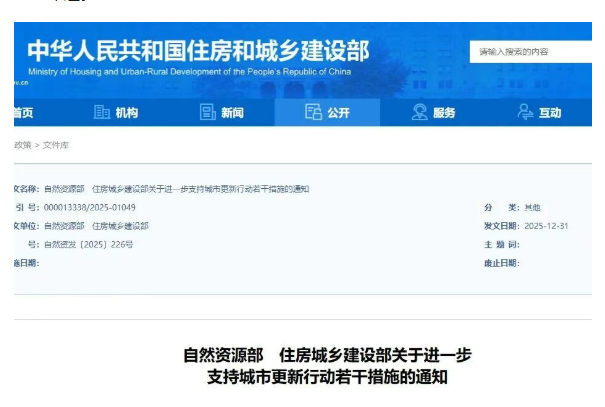
Recently, the Ministry of Natural Resources of the People’s Republic of China and the Ministry of Housing and Urban-Rural Development jointly issued 《关于进一步支持城市更新行动若干措施的通知》 (Document No. 自然资发〔2025〕226号), marking a structurally significant consolidation of China’s urban renewal framework.
Combined with industry estimates indicating that total investment in urban renewal during the “15th Five-Year Plan” period is expected to exceed RMB 20 trillion, policy support, financial resources, and market restructuring are converging to generate a substantial structural opportunity for the construction and real estate sectors, signalling a potential inflection point after a prolonged market adjustment cycle.
This policy strengthens the regulatory and procedural mechanisms governing how urban renewal projects are planned, approved, financed, and implemented, reinforcing planning control adjustments, land-use governance tools, asset registration systems, transitional land management, bundled asset supply, and the resolution of historical property inconsistencies in order to improve legal clarity and project feasibility.
By embedding flexibility into detailed control plan optimization, introducing positive lists for mixed and composite land use, simplifying micro-renewal approvals, allowing five-year transitional land-use arrangements, enabling the temporary activation of idle assets, promoting bundled land and asset supply, strengthening real estate registration mechanisms, and mandating the lawful resolution of historical legacy issues, the document reinforces the institutional architecture that makes large-scale stock-based urban regeneration legally executable, financially viable, and compatible with ESG-oriented investment frameworks. As a result, urban renewal in China is entering a system-embedded implementation stage, shifting from pilot experimentation toward structured institutional consolidation and long-term capital alignment.
中国夯实城市更新的制度基础
近日,中华人民共和国自然资源部与住房和城乡建设部联合印发《关于进一步支持城市更新行动若干措施的通知》(文件号:自然资发〔2025〕226号),标志着中国城市更新框架在制度层面的结构性巩固。
结合行业测算,“十五五”期间城市更新总投资规模预计将超过20万亿元人民币,政策支持、金融资源与市场结构重塑正在形成合力,为建筑与房地产行业释放出显著的结构性机遇,并在长期市场调整周期之后释放出潜在拐点信号。
该政策强化了城市更新项目在规划、审批、融资与实施全过程中的监管与程序机制,通过加强控规优化、土地用途治理工具、资产登记体系、过渡期用地管理、捆绑式资产供给以及历史遗留不动产问题的依法解决,提升法律明确性与项目可行性。
通过在详细控制性规划优化中嵌入灵活性、建立混合与复合用地正面清单、简化微更新审批、允许五年过渡期用地安排、激活闲置资产临时利用、推进土地与资产捆绑供应、强化不动产登记机制并依法化解历史遗留问题,该文件强化了制度架构,使大规模存量型城市更新在法律上可执行、在财务上可行,并与ESG导向的投资框架相兼容。由此,中国城市更新正进入制度嵌入式实施阶段,从试点探索迈向结构化制度整合与长期资本对接。
I. Policy Context and Strategic Positioning
China’s urbanization model is transitioning from land-driven expansion toward stock optimization and quality upgrading. Key structural drivers include:
• Slower greenfield land expansion
• Adjustment within the real estate sector
• Rising expectations for liveability and public services
• Industrial upgrading within existing urban cores
• National carbon-neutrality commitments
• Increasing need for fiscal sustainability at municipal level
During the 2019–2024 period, urban renewal was elevated strategically, but implementation often faced rigidities:
• Detailed control plans were slow to adjust.
• Mixed-use conversion lacked predictable compliance channels.
• Land-use changes triggered immediate financial obligations.
• Historical land and property inconsistencies delayed projects.
• Financing institutions faced regulatory uncertainty.
Document No. 226 addresses these bottlenecks directly. It embeds renewal into the core architecture of spatial planning, land regulation, and asset governance.
The result is not rhetorical expansion but institutional consolidation.
I. 政策背景与战略定位
中国的城市化模式正由土地驱动型扩张转向存量优化与质量升级。关键结构性驱动因素包括:
• 新增建设用地扩张放缓
• 房地产行业结构性调整
• 居住宜居性与公共服务预期提升
• 存量城市核心区产业升级
• 国家碳中和承诺
• 地方财政可持续性压力上升
在2019—2024年期间,城市更新在战略层面得到提升,但实际落地常面临刚性约束:
• 控规调整周期较长。
• 混合用地转换缺乏明确合规路径。
• 土地用途变更触发即时财务负担。
• 历史土地与产权问题延缓项目进度。
• 融资机构面临监管不确定性。
226号文件正面回应上述瓶颈,将城市更新嵌入空间规划、土地监管与资产治理的核心制度架构之中。
其结果并非口号式扩展,而是制度性巩固。
II. Detailed Policy Content Analysis
The document introduces targeted adjustments across planning, land, registration, and implementation mechanisms. Below is a comprehensive breakdown.
A. Strengthening Adaptability of Detailed Control Plans (控规优化)
Local governments are authorized to review and optimize detailed control plans in renewal areas through statutory procedures, adjusting land-use structure, development intensity, and spatial layout while ensuring integration into the national spatial planning “One Map” supervision system.
This allows:
• Rebalancing of residential, commercial, industrial, and public functions.
• Adjustment of FAR within legal parameters.
• Introduction of composite land-use configurations.
• Reallocation of public-service indicators aligned with renewal needs.
This reform reduces structural rigidity while preserving regulatory coherence.
B. Establishment of Positive Lists for Mixed and Composite Land Use
Local authorities may establish positive lists identifying permitted mixed-use formats and emerging industries. Projects included in these lists are deemed compliant with planning requirements.
This mechanism enhances:
• Predictability in industrial upgrading.
• Transparency in compliance.
• Reduction of approval uncertainty.
• Acceleration of functional transformation within existing districts.
C. Micro-Renewal Planning Permit Exemption Mechanisms
Projects that improve public services—such as elevator retrofitting, EV charging infrastructure, accessibility upgrades, and community green-space enhancement—may be included in exemption lists under defined safety and structural conditions.
This significantly lowers procedural friction for small-scale improvements and supports people-centered urban regeneration.
D. Five-Year Transitional Land-Use Arrangement
Existing land introducing new industries or business models during renewal may operate under transitional status for up to five years.
This provides:
• Time-based regulatory flexibility.
• Phased land premium adjustments.
• Market testing opportunities.
• Reduced immediate financial burden.
This is one of the most structurally innovative measures within the document.
E. Temporary Use of Existing Land and Space
Idle land and underutilized buildings may be temporarily activated to generate economic vitality and reduce vacancy during redevelopment cycles.
This institutionalizes interim use within formal renewal strategy.
F. Bundled Land and Asset Supply
Integrated packaging of multiple parcels within renewal districts is encouraged, enabling cross-subsidization between commercial and public-interest components and improving district-level structuring.
G. Innovation in Real Estate Registration Services
Advance unit filing and priority notice registration mechanisms improve asset rights clarity and reduce transaction uncertainty, enhancing financing feasibility.
H. Resolution of Historical Legacy Issues
Local authorities must lawfully resolve unresolved land-use and property inconsistencies, unlocking dormant assets and removing legal bottlenecks.
II. 政策内容结构性解析
该文件在规划、土地、登记与实施机制层面提出针对性调整,具体分析如下。
A. 强化控规适应性(控规优化)
授权地方政府依照法定程序对更新区域控规进行评估与优化,在确保纳入国土空间规划“一张图”监管体系的前提下,调整用地结构、开发强度与空间布局。
实现:
• 住宅、商业、工业与公共功能的结构再平衡。
• 在合法范围内调整容积率。
• 引入复合型用地配置。
• 根据更新需求重新配置公共服务指标。
该改革在保持监管一致性的同时降低结构刚性。
B. 建立混合与复合用地正面清单
地方可建立正面清单,明确允许的混合用地形式与新兴产业类型。列入清单的项目视为符合规划要求。
该机制提升:
• 产业升级可预期性。
• 合规透明度。
• 审批不确定性降低。
• 既有城区功能转型加速。
C. 微更新规划许可豁免机制
在符合安全与结构条件前提下,涉及公共服务提升的项目(如加装电梯、充电设施、无障碍改造、社区绿地提升等)可纳入豁免清单。
显著降低小规模改善的程序摩擦,支持以人为本的城市更新。
D. 五年过渡期用地安排
在更新过程中引入新产业或新业态的既有土地,可在最长五年内实行过渡期管理。
提供:
• 时间维度的监管弹性。
• 分阶段土地出让金调整。
• 市场测试空间。
• 减轻即时财务负担。
这是文件中结构性创新程度较高的措施之一。
E. 既有土地与空间临时利用
允许对闲置土地与低效建筑进行临时激活,在再开发周期内创造经济活力并降低空置率。
将过渡性利用制度化纳入更新战略。
F. 土地与资产捆绑供应
鼓励在更新片区内对多宗地块进行一体化打包供应,实现商业与公益部分交叉补贴,优化片区级结构设计。
G. 不动产登记服务创新
通过预登记与优先权登记机制,提升产权清晰度、降低交易不确定性,增强融资可行性。
H. 历史遗留问题依法化解
地方政府需依法解决历史土地与产权不一致问题,释放沉睡资产,清除法律障碍。
III. Capital-Market Implications
Document No. 226 substantially improves capital-market compatibility.
It reduces regulatory risk through:
• Formalized planning adjustment pathways.
• Positive-list compliance predictability.
• Transitional land-use flexibility.
• Enhanced asset registration clarity.
This compresses regulatory risk premiums and improves underwriting confidence.
The transitional mechanism increases embedded optionality in stock assets, enhancing their real-option value and supporting repricing of underutilized urban properties.
Bundled asset supply strengthens structured financing potential, enabling diversified revenue streams and improved compatibility with long-term capital, including insurance funds and urban regeneration platforms.
The shift toward phased redevelopment supports yield-oriented asset management models rather than short-cycle demolition-driven strategies.
III.资本市场影响
226号文件显著提升与资本市场的兼容性。
通过以下方式降低监管风险:
• 规划调整路径制度化。
• 正面清单合规可预期。
• 过渡期用地弹性。
• 资产登记明确性提升。
压缩监管风险溢价,提高承销信心。
过渡机制提升存量资产的嵌入式期权价值,支持低效城市资产重新定价。
捆绑式资产供应增强结构化融资潜力,支持多元化收入结构,与长期资本(包括保险资金与城市更新平台)更加匹配。
分阶段开发模式转向收益导向型资产管理,而非短周期拆建模式。
IV. Comprehensive Stakeholder Impact
The policy generates measurable, structured benefits across the full urban renewal value chain.
• Investors
Lower Regulatory Risk Premium
Clearer planning adjustment mechanisms and positive-list compliance reduce approval uncertainty, allowing investors to price projects with greater confidence and narrower risk spreads.
Improved Asset Clarity
Enhanced registration procedures and lawful resolution of legacy issues improve title transparency, strengthen collateral reliability, and facilitate due diligence processes.
Enhanced Structured Financing Feasibility
Bundled land supply and phased land-use adjustment enable portfolio-based structuring, diversified revenue composition, and improved compatibility with institutional capital allocation models.
• Developers
Greater Functional Flexibility
Mixed-use positive lists and planning optimization allow developers to reposition assets toward higher-value functions aligned with market demand.
Phased Capital Deployment
The five-year transitional mechanism permits staged investment, reducing upfront capital pressure and enabling adaptive redevelopment strategies.
Reduced Immediate Land-Conversion Burden
Deferred land-use adjustment mitigates financial shock and improves project feasibility during early repositioning phases
• Architectural & Engineering Firms
Expanded Adaptive Reuse Demand
Stock optimization increases demand for expertise in retrofitting, spatial reconfiguration, and functional upgrading within existing structural constraints.
Mixed-Use Design Opportunities
Composite land-use integration requires advanced planning and engineering coordination, increasing demand for multidisciplinary technical solutions.
ESG-Aligned Retrofitting Projects
Energy-efficiency upgrades, smart-building integration, and low-carbon design solutions become central components of renewal projects.
• Construction & Decoration Companies
Incremental Upgrading Pipeline
Micro-renewal projects generate stable streams of smaller-scale contracts focused on retrofitting and infrastructure upgrading.
Infrastructure Retrofit Expansion
District-level renewal requires modernization of utilities, public facilities, and accessibility systems, expanding retrofit-related construction activity.
• Materials & Equipment Suppliers
Growing Demand for Energy-Efficient Systems
Urban retrofitting stimulates demand for high-performance insulation, low-carbon materials, smart energy management systems, and sustainable construction components.
Electrification and Smart Building Integration
Installation of elevators, EV charging systems, digital control platforms, and energy monitoring equipment creates long-term equipment supply opportunities.
• Project Management & Certification Firms
Regulatory Advisory
More complex planning and land-use adjustments increase demand for compliance advisory services.
ESG Compliance Services
Integration of sustainability standards requires structured ESG documentation and reporting.
Carbon Accounting
Adaptive reuse and energy upgrades necessitate lifecycle assessment and emissions accounting services.
Risk Management
Phased redevelopment and bundled asset structures require enhanced financial and operational risk oversight.
IV. 对利益相关方的综合影响
政策在城市更新全价值链上形成结构性、可量化收益。
• 投资方
监管风险溢价降低
明确的规划调整机制与正面清单制度降低审批不确定性,风险定价更为可控。
资产清晰度提升
登记机制完善与历史问题化解提升产权透明度与抵押可靠性,便利尽职调查。
结构化融资可行性增强
捆绑供应与分阶段用地调整支持组合式结构设计,与机构资本配置模式更兼容。
• 开发商
功能灵活性提升
混合用地正面清单与规划优化支持资产向高价值功能转型。
资本分阶段投入
五年过渡期机制降低前期资本压力,支持渐进式更新策略。
即时土地转换负担降低
延缓土地用途调整减轻财务冲击。
• 建筑与工程设计机构
存量改造需求扩张
推动对改造、空间重构与功能升级专业能力的需求。
混合功能设计机会增加
复合用地需要更高水平的规划与工程协同。
ESG导向改造项目增加
节能升级、智慧建筑与低碳设计成为核心内容。
• 施工与装饰企业
渐进式改造项目稳定增长
微更新带来持续的小规模合同。
基础设施改造扩张
公用设施与无障碍系统升级需求增加。
• 材料与设备供应商
节能系统需求增长
高性能保温材料、低碳建材与智慧能源系统需求上升。
电气化与智慧化升级
电梯、充电设施与数字控制平台带来长期设备需求。
• 项目管理与认证机构
合规咨询需求上升
规划与用地调整复杂度提高。
ESG服务需求增强
可持续标准整合需系统化报告。
碳核算需求增长
生命周期评估与排放核算服务需求增加。
风险管理强化
分阶段开发与资产打包结构需更完善风险管理。
V. ESG and Carbon-Neutrality Linkage
Urban renewal directly supports national sustainability objectives.
Adaptive reuse reduces embodied carbon emissions compared to demolition and reconstruction. Energy-efficiency retrofits improve operational performance of aging building stock.
Clearer regulatory pathways allow ESG metrics to be integrated at early planning stages, aligning renewal projects with institutional investor sustainability requirements.
Urban regeneration thus becomes a practical channel for advancing carbon-neutrality implementation in the built environment.
V. ESG与碳中和衔接
城市更新直接支撑国家可持续发展目标。
适应性再利用较拆除重建显著降低隐含碳排放;节能改造提升既有建筑运营绩效。
明确的监管路径使ESG指标在早期规划阶段即可整合,与机构投资者可持续要求对接。
城市更新成为建筑环境推进碳中和的重要实践渠道。

VI. Positive Implications for European Companies
The document strengthens regulatory predictability, improving conditions for international engagement.
European companies, included SMEs, with specialized expertise in sustainable materials, smart systems, adaptive reuse design, and ESG certification may find enhanced compatibility with China’s institutionalized renewal model.
A. Specialized Technical Niches
European companies often lead in:
• Energy-efficient retrofitting systems
• Sustainable building materials
• Smart energy management technologies
• Elevator modernization
• Accessibility design
• Carbon accounting and ESG advisory
The micro-renewal exemption mechanism and retrofit focus create scalable demand for such technologies.
B. Engineering and Design Excellence
European architectural and engineering SMEs specializing in:
• Brownfield redevelopment
• Industrial heritage transformation
• Mixed-use regeneration
• Low-carbon urban design
May find opportunities in technical partnerships.
C. Certification and ESG Services
European firms with experience in:
• Environmental certification
• Lifecycle assessment
• Sustainable urban regeneration
Can contribute value in structured ESG integration.
The policy’s procedural clarity lowers entry barriers related to regulatory ambiguity, which has historically limited SMEs participation.
VI. 对欧洲企业的积极意义
该文件强化监管可预期性,为国际合作改善制度环境。
具备可持续材料、智慧系统、适应性设计与ESG认证专业能力的欧洲企业(包括中小企业)与中国制度化更新模式的契合度提升。
A. 专业技术细分领域
欧洲企业在以下领域具备优势:
• 节能改造系统
• 可持续建材
• 智慧能源管理
• 电梯现代化
• 无障碍设计
• 碳核算与ESG咨询
微更新豁免机制与改造导向创造规模化需求。
B. 工程与设计能力
在以下领域具备经验的欧洲建筑与工程中小企业:
• 棕地再开发
• 工业遗产转型
• 混合功能再生
• 低碳城市设计
可在技术合作中寻找机会。
C. 认证与ESG服务
具备以下经验的欧洲企业:
• 环境认证
• 生命周期评估
• 可持续城市再生
可在结构化ESG整合中创造价值。
程序明确性降低了以往限制中小企业参与的监管不确定性门槛。
VII. Quantitative Implementation Outlook (2026–2030)
While no specific national targets are defined in the document, structural indicators suggest:
• Increasing designation of renewal districts.
• Rising proportion of investment allocated to stock optimization.
• Expansion of micro-renewal projects in aging communities.
• Growth of district-level integrated redevelopment platforms.
Given the scale of China’s urban building stock, even incremental efficiency improvements represent substantial economic and environmental impact over the next five-year cycle.
VII. 2026—2030定量实施展望
尽管文件未设定具体国家目标,但结构性趋势显示:
• 更新片区数量将持续增加。
• 投资向存量优化倾斜比例上升。
• 老旧社区微更新项目扩张。
• 片区级综合开发平台增长。
鉴于中国庞大的城市存量建筑规模,即便渐进式效率提升,也将在未来五年周期内产生显著经济与环境影响。
VIII. Strategic Conclusion
Document No. 226 represents a confident institutional evolution.
Urban renewal in China is transitioning from strategic orientation to procedural consolidation, from demolition-driven cycles to stock-based optimization, and from experimental pilots to system-embedded regulatory support.
The policy strengthens alignment between planning governance, capital structuring, and ESG objectives.
China’s urban regeneration framework is entering a more predictable, investment-compatible, and sustainability-integrated phase.
CNEUCN, together with its academic and business partners, will continue to monitor implementation dynamics, participating in the direct implementation and supporting cross-border cooperation in sustainable urban transformation and ESG-aligned development pathways.
VIII. 战略性结论
226号文件体现制度自信与演进。
中国城市更新正从战略导向迈向程序性整合,从拆建驱动周期转向存量优化模式,从试点探索进入制度嵌入式监管阶段。
政策强化规划治理、资本结构与ESG目标之间的协同。
中国城市再生框架正进入更可预期、更具投资兼容性、更加融合可持续目标的新阶段。
CNEUCN将携手学术与产业伙伴,持续关注政策实施动态,参与具体落地实践,并支持可持续城市转型与ESG导向发展路径的跨境合作。
 EN
EN