
Provincial Differentiation and Strategic Entry Logic for EU SMEs in China Mainland
中国大陆:欧盟中小企业的省级差异化和战略进入逻辑
Overview: China as a Continent-Scale Economy
Between 2023 and 2025, the Chinese Mainland has moved decisively from a post-pandemic rebound into a phase of structural differentiation. While national GDP growth remains positive, the trajectory of individual provinces, industrial drivers, and local policy priorities are increasingly divergent. For European SMEs, understanding this evolution is essential for identifying meaningful market opportunities and avoiding one-size-fits-all approaches.
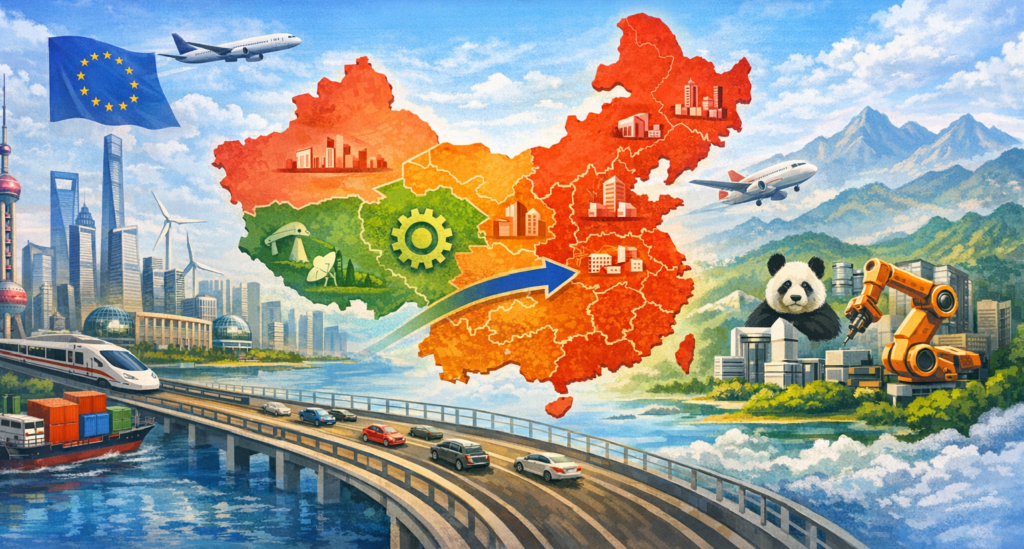
China is no longer a single homogeneous market of 1.4 billion consumers. It now functions more like a continent-scale economy comprising 31 distinct provincial-level systems. Several provinces operate at economic scales comparable to sovereign European nations.
Externally, China is often viewed as a single unified market. Economically, however, it functions more like a continent composed of 31 differentiated provincial economies:
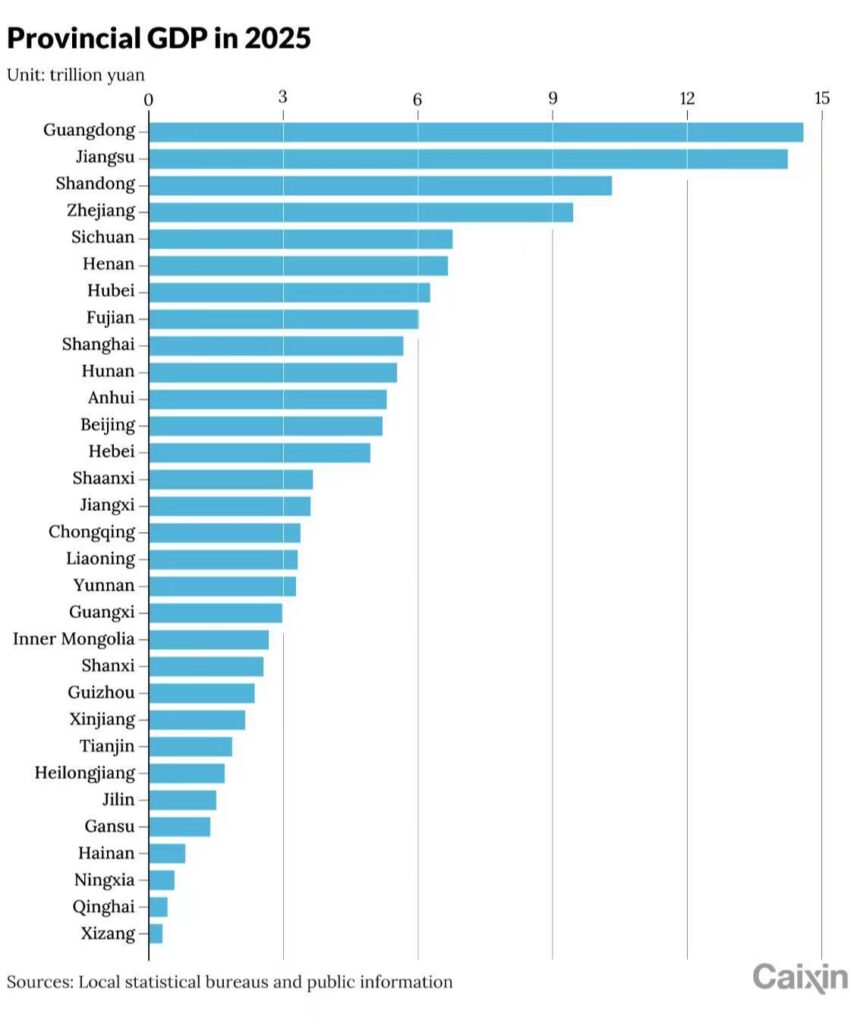
• Guangdong (~RMB 14.6 trillion, 2025 est.) – comparable to Germany
• Jiangsu (~RMB 14.2 trillion, 2025 est.) – comparable to France
• Southwest (Sichuan & Chongqing) has emerged as an innovation and consumption powerhouse.
Even mid-sized provinces rival smaller EU countries in economic output, each representing a fully-fledged ecosystem with unique characteristics, opportunities, and risks.
Provincial economies are shaped by industrial structure, growth momentum, policy priorities, infrastructure development, and openness to foreign cooperation. For EU SMEs, this structural reality makes success depending on provincial fit, industrial alignment, cluster density, and policy compatibility.
Matching company capabilities to local conditions is now the foundation of strategic engagement. Understanding the nuances of the Chinese Mainland provincial dynamics is increasingly the difference between short-term gains and sustainable presence.
概述:作为“大陆型”经济体的中国
2023年至2025年期间,中国大陆已明确从疫情后的复苏阶段迈入结构性分化阶段。尽管全国GDP增长保持正值,但各省发展轨迹、产业驱动力以及地方政策重点日益分化。对于欧盟中小企业而言,理解这一演变对于识别真正有意义的市场机会、避免“一刀切”策略至关重要。
中国已不再是一个拥有14亿消费者的单一同质化市场。如今,它更像一个由31个不同省级体系构成的“大陆型经济体”。多个省份的经济规模已可与欧洲主权国家相当。
从外部视角看,中国常被视为一个统一市场。然而,从经济结构角度来看,它更像由31个差异化省级经济体组成的大陆体系:
• 广东(约人民币14.6万亿元,2025年预估)——相当于德国规模
• 江苏(约人民币14.2万亿元,2025年预估)——相当于法国规模
• 西南地区(四川与重庆)已崛起为创新与消费双重驱动的增长高地
即便是中等规模省份,其经济总量亦可比肩部分欧盟小国。每个省份均构成一个完整生态系统,拥有独特特征、机会与风险。
省级经济由产业结构、增长动能、政策重点、基础设施发展水平以及对外合作开放程度所塑造。对于欧盟中小企业而言,这一结构现实意味着成功取决于省份匹配度、产业对接度、集群密度以及政策兼容性。
将企业能力与地方条件精准匹配,已成为战略参与的基础。深入理解中国大陆省级经济动态的细微差异,越来越成为短期收益与可持续布局之间的关键分水岭。
Macroeconomic Context: Structural Normalization
Between 2023 and 2025, China’s economic environment reflects clear structural priorities. The country is rebalancing away from real estate, strongly supporting advanced manufacturing, advancing carbon neutrality targets for 2030 and 2060, upgrading digital industrial processes, and expanding renewable energy infrastructure. Provincial GDP growth increasingly reflects these policy priorities rather than cyclical recovery.
GDP rankings remain broadly stable, yet beneath this stability lies structural divergence:
• Coastal provinces show scale maturity but slowing marginal growth
• Western regions evolve into innovation and infrastructure platforms
• Central provinces absorb industrial relocation
Anyhow GDP size alone is no longer decisive — industrial composition determines strategic relevance.
Three macro trends shape this landscape:
• Rebalancing away from real estate toward advanced manufacturing and modern services
• Policy prioritization of NEVs, semiconductors, digital infrastructure, green technology and energy security
• Regional coordination to strengthen inland growth poles
For every company, including SMEs, alignment with national and provincial policy becomes a critical market variable. Those engaging proactively with local industrial strategies are better positioned to secure incentives, government cooperation, and competitive advantages, while misalignment increases operational risk and reduces potential returns.
宏观经济背景:结构性常态化
2023年至2025年,中国经济环境体现出清晰的结构性优先方向。国家正逐步摆脱房地产依赖,大力支持先进制造业,推进2030与2060年碳中和目标,加快数字化产业升级,并扩大可再生能源基础设施建设。省级GDP增长越来越反映政策优先方向,而非周期性复苏因素。
GDP排名整体保持稳定,但在这一稳定表象之下存在结构性分化:
• 沿海省份规模成熟,但边际增长放缓
• 西部地区逐步演化为创新与基础设施平台
• 中部省份承接产业转移
无论如何,GDP规模本身已不再具有决定性意义——产业结构才决定战略相关性。
三大宏观趋势塑造当前格局:
• 从房地产转向先进制造与现代服务业
• 政策重点聚焦新能源汽车(NEVs)、半导体、数字基础设施、绿色技术与能源安全
• 区域协调发展以强化内陆增长极
对于包括中小企业在内的所有企业而言,与国家及地方政策方向保持一致,已成为关键市场变量。主动融入地方产业战略的企业,更有机会获得政策激励、政府合作与竞争优势;而政策错位则将增加运营风险并削弱潜在回报。
Coastal Powerhouses: Scale and Maturity
Guangdong, Jiangsu, Shandong, Zhejiang, and Shanghai remain the backbone of China’s economy. These regions combine deep industrial ecosystems, advanced manufacturing capabilities, digital economy integration, and extensive global supply chain connectivity. Their scale and sophistication make them ideal for high-value operations, including R&D partnerships, headquarters functions, and supply chain integration.
However, structural maturity brings slower marginal growth, higher labor and land costs, intense domestic competition, and increasingly complex regulatory requirements. While coastal provinces remain crucial for EU SMEs seeking innovation-driven projects, cost arbitrage strategies are better pursued elsewhere. These regions are platforms for high-value collaboration rather than low-cost production.
• Key Insight for EU SMEs:
Coastal provinces are ideal for R&D partnerships, headquarters functions, and high-value supply chain integration — not for cost arbitrage.
EU SMEs entering these regions benefit from access to cutting-edge industrial know-how and policy visibility, positioning themselves strategically for long-term engagement.
沿海核心区域:规模与成熟度
广东、江苏、山东、浙江与上海仍是中国经济的支柱。这些地区结合了深厚产业生态、先进制造能力、数字经济融合程度以及广泛的全球供应链连接。其规模与成熟度使其成为高价值运营的理想平台,包括研发合作、总部功能与供应链整合。
然而,结构成熟也意味着边际增长放缓、更高的劳动力与土地成本、更激烈的本土竞争以及更复杂的监管要求。尽管沿海地区仍是欧盟中小企业开展创新驱动项目的重要区域,但成本套利策略更适合布局于其他地区。沿海地区更适合作为高价值协作平台,而非低成本生产基地。
• 对欧盟中小企业的关键洞察:
沿海省份适合研发合作、总部功能与高价值供应链整合——而非成本套利。
进入这些区域的欧盟中小企业,可获得前沿产业知识与政策可视性,从而为长期战略布局奠定基础。
Western Dual-Core Growth Engine: Sichuan and Chongqing
Western China has emerged as a structurally significant region, moving beyond its former peripheral status. Sichuan and Chongqing together form a complementary dual-core growth engine that balances innovation, manufacturing, and logistics.
Sichuan: Innovation and Diversification Hub
With a GDP exceeding RMB 6 trillion and ranking among the top five provinces nationally, Sichuan offers balanced growth supported by domestic demand and advanced manufacturing. GDP > RMB 6 trillion (Top 5 nationally).
• Balanced growth: domestic demand + advanced manufacturing
• Electronics, aerospace, agri-food, and digital services
• High human capital density with lower labor costs
• Rail connectivity to Europe via China–Europe Railway Express
Sichuan’s policy environment also fosters experimentation, making it an attractive region for pilot programs and innovative business models. Companies willing to engage closely with local governments can benefit from incentives that accelerate market entry and scaling.
EU SMEs can focus on innovation partnerships, industrial automation, agri-tech, food processing, and energy efficiency initiatives.
Chongqing: Manufacturing and Logistics Pivot
Centrally administered, Chongqing is a key manufacturing and logistics hub with a focus on automotive and electronics production. Its strategic position along the Yangtze River and the Western Land–Sea Corridor enables efficient supply chain integration. EU SMEs can leverage Chongqing for automotive components, NEVs, industrial automation, smart logistics systems, and inland manufacturing operations.
• Centrally administered municipality
• Automotive and electronics production
• Yangtze River logistics gateway
• Western Land–Sea Corridor connectivity
•Key Insight for EU SMEs:
Together, Sichuan and Chongqing provide a balanced combination of innovation, operational scale, and cost efficiency. SMEs can deploy Sichuan as the talent and innovation anchor while using Chongqing for production and logistics, creating an internally coherent ecosystem that maximizes both efficiency and strategic visibility. This pairing illustrates the potential of western provinces to serve not only as cost-effective options but also as centers for strategic growth.
西部双核增长引擎:四川与重庆
中国西部已成为具有结构意义的重要区域,逐步摆脱边缘定位。四川与重庆共同构成创新、制造与物流互补的“双核增长引擎”。
四川:创新与多元化枢纽
四川GDP超过人民币6万亿元,位列全国前五。其增长由内需与先进制造双重驱动。
• 平衡增长:内需 + 先进制造
• 电子信息、航空航天、农食品与数字服务
• 高人力资本密度与较低劳动力成本
• 通过中欧班列实现与欧洲铁路互联
四川政策环境鼓励创新试点,是开展示范项目与创新商业模式的理想区域。愿意与地方政府深度合作的企业,可通过激励政策加速市场进入与规模扩张。
欧盟中小企业可重点布局创新合作、工业自动化、农业科技、食品加工与能源效率提升项目。
重庆:制造与物流枢纽
作为直辖市,重庆是关键制造与物流中心,重点聚焦汽车与电子生产。其依托长江航运通道与西部陆海新通道,实现高效供应链整合。
欧盟中小企业可在汽车零部件、新能源汽车、工业自动化、智能物流系统与内陆制造运营方面布局。
• 直辖市
• 汽车与电子制造
• 长江物流门户
• 西部陆海新通道互联
• 对欧盟中小企业的关键洞察:
四川与重庆形成创新能力、运营规模与成本效率的平衡组合。企业可将四川作为人才与创新锚点,将重庆作为生产与物流基地,构建内部协同生态系统,在效率与战略可视性之间实现最大化。这一组合体现出西部省份不仅是成本选项,更是战略增长中心。
Central Provinces: Emerging Operational Platforms
Henan, Hubei, Hunan, and Fujian are increasingly relevant for EU SMEs seeking cost-effective operational bases. These provinces attract industrial relocation from coastal areas, benefit from strong domestic demand, and are supported by improving logistics infrastructure and active local government incentives.
Hubei, with Wuhan at its center, presents opportunities in automotive, optoelectronics, and biotech. Henan has developed scale in agri-processing and logistics, while Hunan hosts a construction machinery cluster. Fujian remains trade-oriented with a flexible private sector. Central provinces are ideal for manufacturing platforms, pilot projects, domestic market testing, and establishing long-term operational presence.
• Key Insight for EU SMEs:
These regions are increasingly attractive for EU SMEs because they combine growing industrial density with lower operational costs and active government facilitation. Unlike mature coastal regions, central provinces often allow companies to shape the local industrial ecosystem and benefit from first-mover advantages in emerging clusters.
中部省份:新兴运营平台
河南、湖北、湖南与福建,正日益成为寻求成本效益型运营基地的欧盟中小企业的重要区域。这些省份承接来自沿海地区的产业转移,受益于强劲的国内需求、持续改善的物流基础设施以及积极的地方政府激励政策。
湖北以武汉为中心,在汽车、光电子与生物技术领域具备发展机遇。河南在农产品加工与物流领域形成规模优势,湖南拥有工程机械产业集群。福建保持外向型贸易导向与灵活的民营经济结构。
中部省份适合作为制造平台、试点项目基地、国内市场测试区域以及长期运营布局的基础。
• 对欧盟中小企业的关键洞察:
这些区域对欧盟中小企业日益具有吸引力,因为它们在产业密度提升的同时保持较低的运营成本,并提供积极的政府协助。与成熟沿海地区不同,中部省份往往允许企业在新兴集群中塑造本地产业生态,并获得先发优势。
Policy and Institutional Hubs
Beyond GDP, regions like Beijing, Shanghai, Tianjin, and Hainan exert strategic influence. Beijing remains the regulatory, AI, and biotech nerve center. Shanghai serves as the financial and corporate headquarters hub. Tianjin anchors aerospace and northern port operations, and Hainan functions as an experimental Free Trade Port with regulatory flexibility.
• Key Insight for EU SMEs:
These hubs provide EU SMEs with regulatory access, institutional partnerships, financial structuring capabilities, and opportunities for government engagement. Even companies focused on production or domestic sales should consider these regions as essential nodes for legal compliance, strategic positioning, and partnership cultivation. Strategic presence in these hubs often translates into faster approvals and smoother operational scaling across other provinces.
政策与制度枢纽
除GDP规模外,北京、上海、天津与海南等地区具有战略影响力。北京仍是监管、人工智能与生物技术核心枢纽。上海是金融与企业总部中心。天津承载航空航天与北方港口运营功能,海南则作为具有监管灵活性的自由贸易港试验区发挥作用。
• 对欧盟中小企业的关键洞察:
这些枢纽为欧盟中小企业提供监管通道、制度合作机会、金融架构能力以及政府对接平台。即便企业以生产或国内销售为主,也应将这些地区视为法律合规、战略定位与伙伴培育的关键节点。在这些枢纽建立战略存在,往往意味着在其他省份获得更快审批与更顺畅的运营扩展。
Industrial Clusters: Where Opportunities Concentrate
China’s economic opportunities are increasingly concentrated in specific industrial clusters. Success now depends on understanding which regions combine scale, specialization, and policy support.
• Green Construction and Smart Urban Systems
Construction accounts for over 6% of GDP, with green standard expansion accelerating. EU SMEs can deliver high-efficiency materials, smart building systems, carbon auditing tools, and industrial park energy management solutions. Urban carbon reduction mandates make this cluster attractive for companies capable of blending technological sophistication with sustainable practice.
• Renewable Energy and Grid Infrastructure
China leads globally in wind and solar capacity, with hydrogen pilot projects expanding rapidly. EU SMEs have competitive advantages in smart grid software, energy storage optimization, hydrogen system components, and digital asset management. Strong policy support under carbon neutrality agendas enhances market access, making this cluster both high-opportunity and high-priority for alignment-driven SMEs.
• Electric Vehicles and Battery Ecosystem
China produces over nine million NEVs annually, with 60% of global battery capacity concentrated in Guangdong, Jiangsu, Zhejiang, Anhui, and Sichuan. EU SMEs can contribute in battery recycling, thermal management, precision automation, and advanced testing and certification, though vertical integration and specialization are crucial. Companies must navigate a highly competitive, deeply integrated industry to succeed.
• Semiconductor and Advanced Electronics
This sector is capital-intensive and policy-driven. Key regions include Shanghai for foundries, Jiangsu for equipment and materials, Beijing for design and R&D, and Guangdong for electronics integration. EU SMEs can provide specialty chemicals, fabrication subsystems, and metrology/testing equipment. Navigating regulatory sensitivity, intellectual property frameworks, and export control requirements is essential.
• Consumer and Premium Goods Ecosystem
Retail sales exceed RMB 45 trillion annually. Key markets include Guangdong, Shanghai, Zhejiang, Jiangsu, Beijing, and Hainan. EU SMEs focusing on premium F&B, sustainable consumer goods, design-driven products, and eco-certified brands must adopt digital-first strategies and robust IP protection to succeed in these highly competitive and brand-sensitive markets.
• Aerospace and Advanced Equipment
Shaanxi, Sichuan, and Liaoning host aerospace and advanced equipment clusters. EU SMEs can enter through precision components, composite materials, testing equipment, and industrial digitalization. State-linked ecosystems require careful partnership structuring, emphasizing strategic alignment and trust-building.
• Pharmaceuticals and Medical Technologies
Healthcare expenditure is rising toward 7% of GDP. Hubs include Jiangsu (Suzhou), Shanghai, Beijing, Guangdong, and Sichuan. EU SMEs can provide high-end medical devices, specialty pharmaceuticals, diagnostics, and hospital efficiency software. Centralized procurement and regulatory approval timelines require careful planning but offer long-term strategic value once navigated successfully.
产业集群:机会高度集聚之处
中国的经济机会日益集中于特定产业集群。成功取决于识别哪些区域在规模、专业化与政策支持方面形成叠加优势。
• 绿色建筑与智慧城市系统
建筑业占GDP超过6%,绿色标准推广加速。欧盟中小企业可提供高效建筑材料、智慧楼宇系统、碳审计工具以及工业园区能源管理解决方案。城市碳减排强制要求使该集群对兼具技术深度与可持续实践能力的企业具有吸引力。
• 可再生能源与电网基础设施
中国在风电与太阳能装机容量方面全球领先,氢能试点项目快速扩展。欧盟中小企业在智能电网软件、储能优化、氢能系统部件与数字资产管理方面具备竞争优势。碳中和政策支持强化市场准入,使该集群成为高机会与高优先级领域。
• 新能源汽车与电池生态系统
中国年产新能源汽车超过900万辆,全球60%的电池产能集中于广东、江苏、浙江、安徽与四川。欧盟中小企业可在电池回收、热管理、精密自动化与先进检测认证领域参与,但垂直整合能力与专业化程度至关重要。企业需在高度竞争、深度整合的产业环境中审慎布局。
• 半导体与先进电子
该行业资本密集且政策驱动明显。关键区域包括:上海(晶圆制造)、江苏(设备与材料)、北京(设计与研发)、广东(电子集成)。欧盟中小企业可提供特种化学品、制造子系统与计量检测设备。必须高度重视监管敏感性、知识产权框架与出口管制要求。
• 消费与高端商品生态
社会消费品零售总额每年超过45万亿元人民币。核心市场包括广东、上海、浙江、江苏、北京与海南。聚焦高端食品饮料、可持续消费品、设计驱动型产品与生态认证品牌的欧盟中小企业,需采取数字优先战略并强化知识产权保护,以在高度竞争且品牌敏感的市场中取得成功。
• 航空航天与高端装备
陕西、四川与辽宁形成航空航天与高端装备集群。欧盟中小企业可通过精密零部件、复合材料、检测设备与工业数字化进入市场。涉及国有体系的生态结构要求谨慎的合作架构设计,并强调战略对齐与信任构建。
• 医药与医疗技术
医疗支出正接近GDP的7%。核心区域包括江苏(苏州)、上海、北京、广东与四川。欧盟中小企业可提供高端医疗器械、专科药品、诊断技术与医院效率软件。集中采购与审批周期需审慎规划,但一旦成功进入,将具备长期战略价值。
Why Provincial Analysis Matters
Provincial GDP analysis provides insights that go beyond national averages. It clarifies scale equivalence, highlights industrial drivers, identifies early signals of structural upgrading, and mitigates operational risks. For instance, a mid-sized province shifting toward high-tech manufacturing may present stronger long-term potential than a mature coastal hub. Incorporating these insights into strategic planning allows SMEs to optimize operational efficiency, policy alignment, and market entry timing.
为什么省级分析至关重要
省级GDP分析所提供的洞察远超国家平均数据。它揭示规模等效性,识别产业驱动因素,捕捉结构升级的早期信号,并降低运营风险。例如,一个正向高技术制造转型的中等规模省份,可能比成熟沿海枢纽拥有更强的长期潜力。将这些洞察纳入战略规划,有助于中小企业优化运营效率、政策对齐与市场进入时机。
Strategic Framework for EU SMEs
A successful China strategy requires multi-dimensional analysis: evaluating market depth, sectoral concentration, and growth trajectory. Multi-regional engagement is increasingly effective: headquarters in Shanghai, regulatory liaison in Beijing, advanced supply chain integration in Jiangsu or Guangdong, innovation and talent acquisition in Sichuan, manufacturing and logistics in Chongqing, and domestic market expansion in central provinces. Functional segmentation, rather than geographic simplification, is now essential.
Alignment with national policy priorities—carbon neutrality, advanced manufacturing, energy security, semiconductor substitution, and digital industrial upgrading—enhances access to approvals, incentives, and strategic partnerships, while misalignment introduces structural barriers. Companies that combine functional precision with provincial understanding achieve both resilience and scale.
欧盟中小企业的战略框架
成功的中国战略需要多维度分析:评估市场深度、产业集中度与增长轨迹。多区域布局日益有效:总部设于上海,监管联络设于北京,先进供应链整合布局江苏或广东,创新与人才获取布局四川,制造与物流设于重庆,国内市场拓展布局中部省份。功能分工,而非地理简化,已成为必要条件。
与国家政策重点保持一致——包括碳中和、先进制造、能源安全、半导体替代与数字产业升级——可增强审批获取、政策激励与战略合作机会;政策错位则会形成结构性障碍。兼具功能精准与省级理解能力的企业,将获得韧性与规模优势。
Final Perspective
China remains accessible to EU SMEs, but simplicity is no longer an option. Short-term, distributor-only export strategies are outdated. Today, success depends on provincial precision, industrial depth, and policy alignment. EU SMEs that view China as a differentiated economic continent, rather than a single market abstraction, will find significant opportunities in advanced manufacturing, renewable energy, digitalization, healthcare, green infrastructure, and premium consumption.
Province-level, industry-informed, and growth-sensitive strategies are prerequisites for sustainable engagement in the Chinese Mainland’s evolving economic landscape. Entering China — or scaling further within it — increasingly requires structured analysis, institutional understanding, and the ability to translate policy direction into operational positioning.
For EU SMEs, whether approaching China for the first time or already operating locally, the presence of a trusted cross-border partner can significantly reduce strategic blind spots and accelerate economic and sustainable development. An entity such as CNEUCN brings integrated expertise across industrial ecosystem mapping, government interface management, long-term business structuring, carbon neutrality and ESG alignment. This combination enables companies not only to enter the right provinces and sectors, but also to align with policy priorities, identify credible partners, and build resilient local growth platforms.
To access the full report findings and explore how a structured, tailored approach can support your strategic positioning in China, please contact us at [email protected].
最终视角
中国仍对欧盟中小企业保持开放,但“简单路径”已不复存在。短期、仅依赖经销商的出口策略已过时。如今,成功依赖于省级精准布局、产业深度参与与政策对齐。
将中国视为一个差异化经济大陆,而非单一市场抽象概念的欧盟中小企业,将在先进制造、可再生能源、数字化、医疗健康、绿色基础设施与高端消费领域发现重要机遇。
以省份为单位、以产业为导向、以增长趋势为敏感变量的战略,是在中国大陆不断演进的经济格局中实现可持续参与的前提。进入中国——或在中国进一步扩展——越来越需要结构化分析、制度理解以及将政策方向转化为运营定位的能力。
对于首次进入中国或已在本地运营的欧盟中小企业而言,拥有值得信赖的跨境合作伙伴可显著减少战略盲区,加速经济与可持续发展进程。类似 CNEUCN 这样的机构,整合产业生态映射、政府对接管理、长期业务结构设计、碳中和与ESG对齐等专业能力,使企业不仅能够进入合适的省份与行业,还能够与政策优先方向保持一致、识别可信合作伙伴,并构建具有韧性的本地增长平台。
如需获取完整报告成果,或探讨结构化、定制化方法如何支持您在中国的战略布局,请通过[email protected]与我们联系。
 EN
EN