

European Commission Proposes the Industrial Accelerator Act to Strengthen Strategic Manufacturing Capacity and Support Industrial Decarbonisation
欧盟委员会提出《工业加速法案》,以加强战略制造能力并推动工业脱碳
Introduction
On 4 March 2026, the European Commission presented a legislative proposal establishing a new regulatory framework aimed at strengthening industrial capacity and supporting the transition toward low-carbon manufacturing across the European Union. The proposal, titled the Industrial Accelerator Act, introduces a set of measures intended to accelerate investment in strategic industrial sectors, support industrial decarbonisation, and reinforce manufacturing capabilities within the EU economy.
The proposed regulation forms part of the EU’s broader policy framework addressing industrial competitiveness, supply chain resilience, and the development of strategic manufacturing ecosystems. The initiative reflects the continued importance of industrial activity in the European economy and proposes regulatory instruments designed to facilitate investment, streamline administrative procedures, and support the deployment of advanced industrial technologies.
At the current stage, the Industrial Accelerator Act is a legislative proposal submitted by the European Commission and will follow the ordinary legislative procedure, requiring review and approval by both the European Parliament and the Council of the European Union before it can enter into force as EU law.
引言
2026年3月4日,欧盟委员会提出了一项立法提案,建立新的监管框架,旨在加强工业能力并支持整个欧盟向低碳制造转型。该提案名为《工业加速法案》(Industrial Accelerator Act),提出了一系列措施,旨在加快对战略工业领域的投资,支持工业脱碳,并强化欧盟经济中的制造能力。
该法规提案是欧盟更广泛政策框架的一部分,该框架旨在提升工业竞争力、增强供应链韧性,并推动战略制造生态系统的发展。该倡议反映了工业活动在欧洲经济中的持续重要性,并提出一系列监管工具,以促进投资、简化行政程序,并支持先进工业技术的部署。
目前,《工业加速法案》仍处于欧盟委员会提出的立法提案阶段。根据欧盟普通立法程序,该提案需经欧洲议会和欧盟理事会审议并批准后,方可正式成为欧盟法律。
Strategic Context of the Industrial Accelerator Act
The legislative proposal highlights the continued significance of manufacturing activities within the European Union’s economic structure. According to the Commission’s analysis, the manufacturing sector accounted for approximately 18.3% of employment in the EU business economy in 2024 and represented 14.3% of EU gross domestic product.
At the same time, the share of manufacturing in the EU’s economic output has gradually declined over the past decades. Data referenced in the proposal indicate that manufacturing represented 17.4% of EU GDP in 2000, reflecting a longer-term trend of structural change within the European economy.
Within this context, the Industrial Accelerator Act seeks to establish a regulatory framework that supports the development of industrial capacity across a number of strategic sectors. The proposal also addresses the need to strengthen industrial ecosystems linked to the transition toward climate-neutral production systems, while reinforcing the resilience of key industrial supply chains.
The regulation therefore aims to provide mechanisms that facilitate industrial investment, support manufacturing expansion, and accelerate the adoption of low-carbon technologies across European industry.
《工业加速法案》的战略背景
该立法提案强调制造业在欧盟经济结构中的持续重要性。根据欧盟委员会的分析,2024年制造业约占欧盟商业经济就业的 18.3%,并贡献 14.3% 的欧盟国内生产总值(GDP)。
与此同时,制造业在欧盟经济产出中的占比在过去几十年逐渐下降。提案引用数据显示,2000年制造业占欧盟GDP的 17.4%,反映出欧洲经济结构长期变化的趋势。
在此背景下,《工业加速法案》旨在建立一个监管框架,以支持多个战略产业领域的工业能力发展。同时,该提案还强调需要加强与气候中和生产体系转型相关的工业生态系统,并提升关键工业供应链的韧性。
因此,该法规旨在通过相关机制促进工业投资、支持制造业扩张,并加快欧洲工业低碳技术的应用。
Strategic Industrial Sectors Covered by the Proposal
The Industrial Accelerator Act identifies a number of strategic industrial sectors that fall within the scope of the proposed regulatory framework. These sectors are considered significant both for the EU’s industrial base and for the development of technologies associated with the energy transition.
Energy-Intensive Industries
A first category covered by the proposal includes several energy-intensive industrial sectors that represent a substantial part of European manufacturing capacity. These sectors include:
• Paper and paper products manufacturing
• Chemicals and chemical products
• Rubber and plastics production
• Refined petroleum products
• Non-metallic mineral products
• Basic metals and metal manufacturing industries
These sectors are among the largest industrial consumers of energy within the EU and are central to many industrial value chains.
Automotive Industry
The proposal also covers key segments of the automotive sector, including:
• Motor vehicle manufacturing
• Production of trailers and semi-trailers
The automotive industry remains a major industrial employer and an important contributor to manufacturing output in several EU Member States.
Net-Zero Technologies
In addition, the Industrial Accelerator Act includes a set of technologies related to the transition toward low-carbon energy systems. These include:
• Solar energy technologies
• Wind energy technologies
• Battery and energy storage technologies
• Electricity grid technologies
• Hydrogen production technologies and electrolysers
• Nuclear energy technologies
• Renewable fuels of non-biological origin
• Hydropower technologies
These technology areas are identified as key components of the EU’s industrial transition toward climate neutrality and the development of advanced manufacturing ecosystems.
提案涵盖的战略工业领域
《工业加速法案》确定了一系列纳入监管框架的战略工业领域。这些领域不仅对欧盟工业基础至关重要,也与能源转型相关技术的发展密切相关。
能源密集型产业
提案首先涵盖多个能源密集型工业部门,这些行业占欧洲制造能力的重要部分,包括:
•纸张及纸制品制造
•化学及化工产品
•橡胶和塑料制品
•精炼石油产品
•非金属矿物制品
•基本金属及金属制造行业
这些行业是欧盟能源消耗最大的工业部门之一,也是多个工业价值链的重要组成部分。
汽车产业
提案还涵盖汽车产业的关键环节,包括:
•机动车制造
•挂车和半挂车生产
汽车产业仍然是欧盟多个成员国的重要工业雇主,并对制造业产出具有重要贡献。
净零技术
此外,《工业加速法案》还包括一系列与低碳能源转型相关的技术领域,例如:
•太阳能技术
•风能技术
•电池和储能技术
•电网技术
•氢能生产技术和电解槽
•核能技术
•非生物来源可再生燃料
•水电技术
这些技术领域被视为欧盟实现气候中和及发展先进制造生态系统的关键组成部分。
Public Procurement and “Made in EU” Requirements
One of the central components of the legislative proposal concerns the introduction of requirements related to origin and carbon intensity within certain policy instruments.
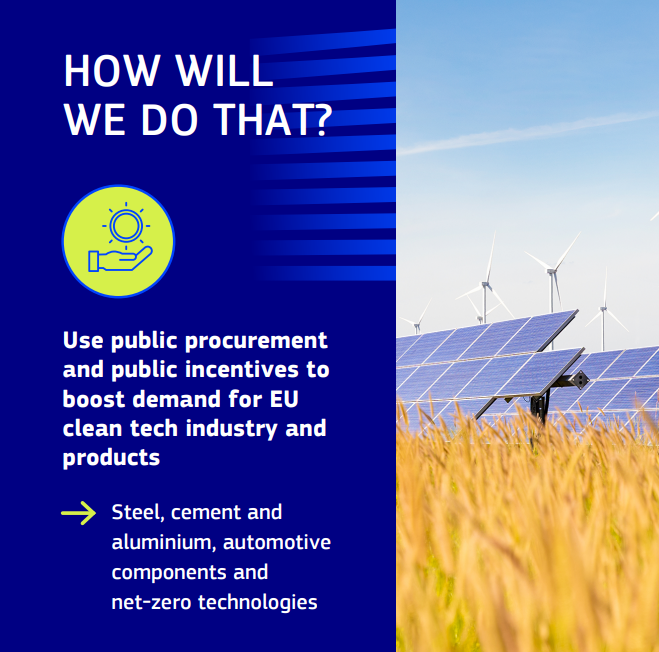
Under the proposed regulation, public procurement procedures and public support schemes in the strategic sectors covered by the Industrial Accelerator Act may include specific eligibility criteria related to:
• Production origin within the European Union
• Carbon intensity of industrial products and technologies
The proposal indicates that such requirements may apply to a range of industrial products and technologies, including:
• Steel
• Cement
• Aluminium
• Vehicles
• Net-zero technologies such as batteries, solar panels, heat pumps, wind turbines and hydrogen electrolysers
The regulation provides that technical criteria defining these requirements may be established through implementing and delegated acts adopted by the European Commission.
These provisions would allow the Commission to define the methodologies and thresholds used to assess eligibility for public procurement procedures and public support mechanisms under the framework of the Industrial Accelerator Act.
公共采购与“欧洲制造”要求
该立法提案的核心内容之一,是在某些政策工具中引入原产地和碳强度要求。
根据提案,在《工业加速法案》涵盖的战略领域中,公共采购程序和公共支持计划可能会引入以下资格标准:
•产品或技术需在欧盟境内生产
•工业产品和技术的碳强度水平
这些要求可能适用于多种工业产品和技术,包括:
•钢铁
•水泥
•铝
•车辆
•净零技术(如电池、太阳能板、热泵、风力涡轮机和氢电解槽)
法规规定,上述技术标准可能通过欧盟委员会制定的实施法案和授权法案来具体确定。
这些条款将使欧盟委员会能够制定相关方法和阈值,用于评估企业是否符合公共采购或公共支持机制的资格。
Streamlining Industrial Permitting Procedures
Another important element of the proposal concerns the simplification and coordination of administrative procedures related to industrial investment projects.
The Industrial Accelerator Act introduces provisions requiring EU Member States to establish a single digital permitting procedure for certain manufacturing projects covered by the regulation.
This digital system would function as a centralised administrative interface through which companies can submit applications and obtain authorisations required for the development of industrial projects in the sectors identified by the regulation.
The objective of the proposed mechanism is to:
•streamline administrative processes
•coordinate the different national authorities responsible for industrial permitting procedures.
The framework would apply to projects related to
•manufacturing capacity expansion
•industrial transformation
• the deployment of relevant technologies within the strategic sectors defined by the regulation.
简化工业许可程序
提案的另一个重要内容涉及工业投资项目相关行政流程的简化与协调。
《工业加速法案》要求欧盟成员国建立单一数字化许可程序,适用于法规所涵盖的部分制造项目。
该数字系统将作为集中式行政平台,使企业能够通过同一渠道提交申请,并获得开展工业项目所需的相关许可。
这一机制的目标是:
•简化行政流程
•协调不同国家主管部门之间的审批程序
该框架适用于以下项目:
•制造能力扩张
•工业转型升级
•战略产业技术部署
Strategic Industrial and Decarbonisation Projects
The proposal also introduces provisions related to the designation and facilitation of strategic industrial and decarbonisation projects.
Under the proposed regulation, certain projects may be identified as strategic where they contribute to:
• the development of industrial manufacturing capacity
• the deployment of low-carbon technologies
• the transformation or modernisation of industrial production systems
Projects receiving this designation may benefit from coordinated regulatory procedures and administrative support within the framework established by the Industrial Accelerator Act.
The objective of these provisions is to facilitate the implementation of projects considered important for the development of industrial ecosystems and the decarbonisation of manufacturing processes within the European Union.
战略工业与脱碳项目
提案还提出有关建立战略工业与脱碳项目机制。
根据拟议法规,如果项目能够促进以下目标,则可能被认定为战略项目:
•提升工业制造能力
•推动低碳技术部署
•改造或升级工业生产系统
被认定为战略项目的投资计划可能获得协调化监管程序和行政支持。
这些措施旨在促进关键项目落地,从而推动欧盟工业生态系统发展和制造业脱碳。
Provisions Concerning Foreign Direct Investment
The Industrial Accelerator Act proposal also contains provisions addressing large foreign direct investments in specific strategic industrial sectors.
According to the draft regulation, additional requirements may apply to foreign investment projects exceeding €100 million in certain sectors, including:
• battery manufacturing
• electric vehicle production
• solar photovoltaic technologies
• critical raw materials
These provisions may apply where a single third country controls more than 40% of global manufacturing capacity in the relevant sector.
In such cases, the proposal indicates that qualifying investment projects may need to demonstrate elements including:
• job creation within the European Union
• contributions to innovation and economic growth
• technology and knowledge transfer
• local value creation
These conditions are part of the regulatory framework outlined in the draft legislation and would be assessed according to criteria established under the regulation.
外国直接投资相关规定
《工业加速法案》提案还涉及特定战略产业中的大型外国直接投资(FDI)。
根据法规草案,在某些领域,超过1亿欧元的外国投资项目可能需要满足额外要求,例如:
•电池制造
•电动汽车生产
•太阳能光伏技术
•关键原材料
当某一第三国在相关产业中的全球制造能力超过40%时,这些规定可能适用。
在这种情况下,投资项目可能需要证明以下方面:
•在欧盟创造就业
•促进创新和经济增长
•技术与知识转移
•本地价值创造
这些条件将根据法规设定的评估标准进行审核。
Coordination with Existing EU Regulatory Frameworks
The Industrial Accelerator Act also includes provisions intended to ensure coordination with existing European regulatory frameworks relevant to industrial activity and decarbonisation.
The proposal introduces mechanisms allowing the European Commission to establish harmonised definitions and criteria for certain low-carbon industrial products and technologies.
The regulation also provides the possibility for the Commission to adopt delegated acts defining methodologies related to the assessment of low-carbon materials and products used in industrial manufacturing processes.
These provisions are intended to ensure regulatory consistency between the Industrial Accelerator Act and other EU policy instruments related to
• industrial emissions
• vehicle standards
• climate transition policies.
与现有欧盟监管框架的协调
《工业加速法案》还包括确保与现有欧盟法规协调的条款。
提案允许欧盟委员会制定低碳工业产品和技术的统一定义和标准,通过授权法案制定低碳材料和产品评估方法。
这些规定旨在确保《工业加速法案》与其他欧盟政策工具之间的监管一致性,例如:
•工业排放法规
•车辆排放标准
•气候转型政策
Legislative Process and Next Steps
At present, the Industrial Accelerator Act remains a legislative proposal presented by the European Commission.
Under the EU’s legislative procedures, the draft regulation will be examined through the ordinary legislative process, involving discussions and negotiations between the European Parliament and the Council of the European Union.
During this process, the proposal may be amended before a final text is adopted. Once approved by both institutions, the regulation would become directly applicable in all EU Member States.
立法程序与下一步
目前,《工业加速法案》仍为欧盟委员会提出的立法提案。
根据欧盟立法程序,该草案将通过普通立法程序进行审议,包括欧洲议会和欧盟理事会。
在这一过程中,提案内容可能被修改。只有在两大机构批准最终文本后,该法规才会正式生效,并在所有欧盟成员国直接适用。
Conclusion
The Industrial Accelerator Act proposed by the European Commission establishes a comprehensive regulatory framework aimed at strengthening industrial manufacturing capacity and supporting the transition toward low-carbon industrial production across the European Union.
The proposal introduces a range of measures covering
• public procurement requirements
• industrial permitting procedures
• strategic project frameworks
• conditions related to certain foreign direct investments.
It also identifies a set of strategic industrial sectors, including energy-intensive industries, automotive manufacturing and technologies associated with the development of low-carbon energy systems.
As the proposal enters the European legislative process, it will be reviewed and debated by the European Parliament and the Council of the European Union before any final regulation is adopted.
结论
欧盟委员会提出的《工业加速法案》旨在建立一个全面的监管框架,以加强欧盟工业制造能力,并推动工业生产向低碳转型。
该提案涵盖多个政策领域,包括:
•公共采购规则
•工业许可程序
•战略项目支持机制
•特定外国投资条件
同时,提案明确了一系列战略产业,包括能源密集型行业、汽车制造以及低碳能源技术相关产业。
随着提案进入欧盟立法程序阶段,欧洲议会和欧盟理事会将对其进行审议和讨论,在最终法规通过之前,相关内容仍可能发生调整。
 EN
EN